How to Choose an Edge AI Computer for Mobile Robots
Learn how to size an edge AI platform for mobile robots, from monocular mowers to stereo depth. See D-Robotics at electronica 2026.

Choosing an edge AI computer starts with the robot's workload. A monocular robot may need target detection and segmentation. A robot that must measure obstacle distance or free space needs stereo depth. Interaction functions such as body keypoint detection add another model and latency budget.
This year, at electronica 2026 in Munich, together with our solution partner Fibocom, D-Robotics will demonstrate how our edge computing platforms and robot perception algorithms address these workloads. Our joint solutions, D-Robotics product portfolio and live demos will be featured at Fibocom’s booth (Hall C2, Booth C2.724).
Define the Workload Before Choosing a Platform
Peak TOPS is only one part of the choice. The platform must also match the sensors, the models that run together, the latency target and the product cost. Four questions define the workload.
- Does the robot need 2D detection and segmentation, or must it also measure depth and free space?
- Will it use one camera, a stereo pair, RTK, LiDAR or a fused sensor stack?
- Will the edge computer run perception only, or also localization, planning and control?
- How much compute is required for additional functions such as pose detection and audio interaction?
A focused monocular workload can run on Sunrise 3. RDK X5 adds stereo camera support for depth and interaction applications, while RDK S100 provides more compute for higher-definition stereo and concurrent models.
See How Sunrise 3 Supports a Monocular Lawn Mower
A wire-free mower for a small residential lawn can operate with 2D perception from one camera. It must recognize grass, find the working boundary, and detect obstacles soon enough to change course.
Powered by the Sunrise 3 AI computing platform, the lawn mower can leverage 5 TOPS of on-device AI computing power, visual perception, and efficient AI inference for the two core perception tasks.
- Target detection identifies discrete obstacles in the mower's path.
- Lawn segmentation classifies grass and non-grass regions so that the navigation stack can stay within the working area.
These perception results can support boundary recognition, obstacle avoidance, wire-free operation, and return to charge. With only one camera, the architecture also keeps sensor count and system cost under control.
In the joint exhibit, D-Robotics provides the Sunrise 3 edge computing platform for vision processing and AI model execution. Fibocom integrates the monocular camera, algorithm board, drive board, and the perception, navigation, and control stack. The reference design targets small lawns of up to 600 square meters.
The joint mower design shows how Sunrise 3 supports a focused monocular workload. Mobile robots that also need distance and free-space information require synchronized stereo input and a platform sized for depth estimation.
Evaluate Stereo Depth on RDK X5 and RDK S100
Stereo vision gives the robot local 3D information. It compares synchronized left and right images to calculate disparity and depth, which the robot can use for obstacle distance, free space analysis and local path planning.
For outdoor mobile robots, stereo depth can be combined with RTK-enabled GNSS for global positioning. The compute platform must then handle depth estimation, localization, and any concurrent perception models within the target latency. At the booth, Magicbox shows this visual depth capability on X5, while D-Stereo shows higher-definition stereo depth on S100.
Experience X5 Stereo Depth Through Magicbox
RDK X5 provides up to 10 TOPS of AI performance, an eight-core Arm Cortex-A55 CPU, and two four-lane MIPI CSI camera interfaces. At electronica, an RDK X5 Magicbox demo will use its synchronized stereo camera to show depth estimation. Magicbox is an RDK X5-based multimodal product, and this exhibit presents X5 stereo-depth capability.
The demo turns paired camera images into depth information that can support obstacle-distance estimation and free-space perception. For products that need one stereo pair and a moderate model load, RDK X5 provides the compute and camera interfaces for this workload.
See Higher-Definition D-Stereo on RDK S100
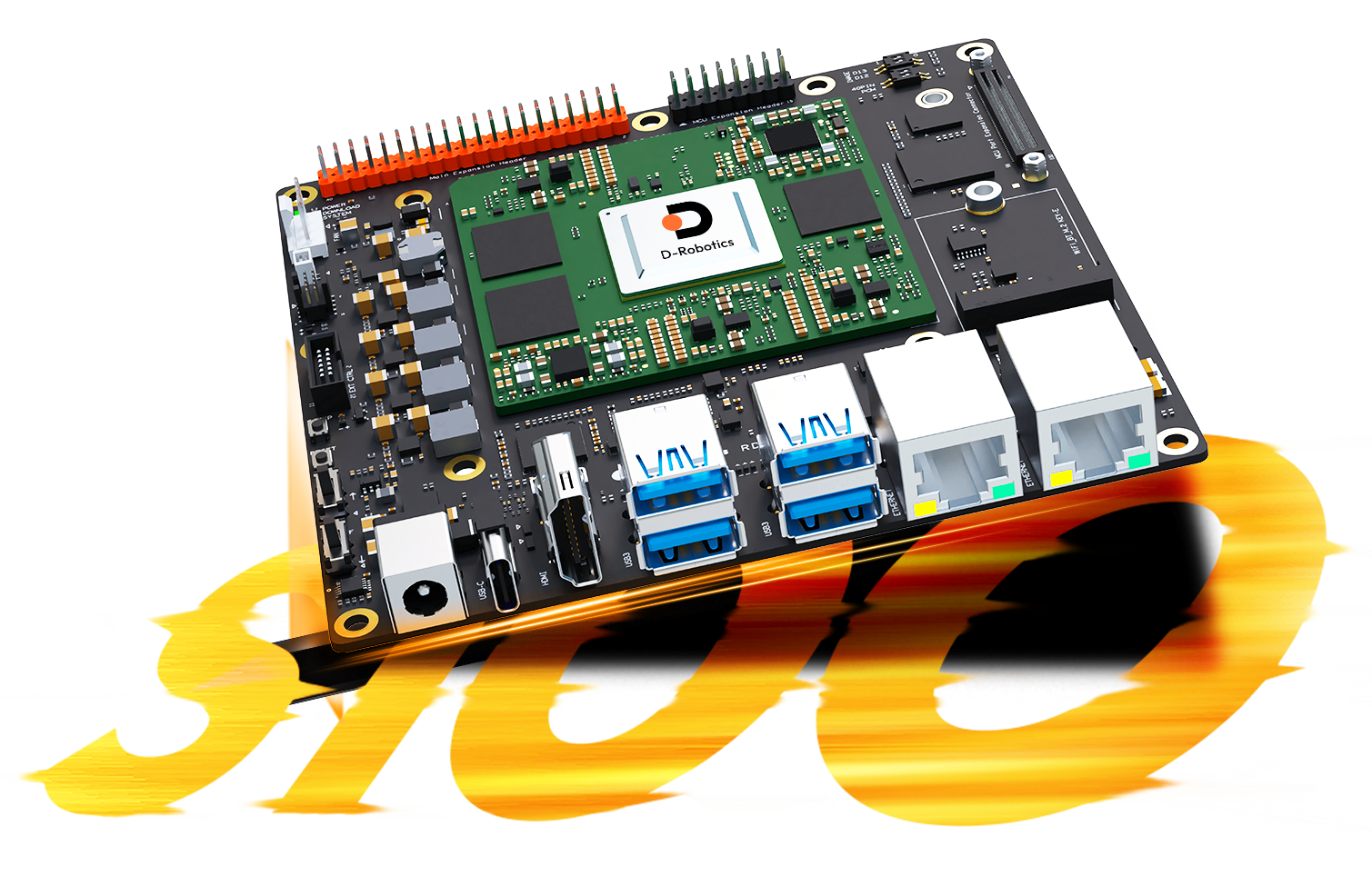
RDK S100 combines an 80 TOPS BPU with six Arm Cortex-A78AE CPU cores and four Arm Cortex-R52+ MCU cores. This heterogeneous architecture gives perception inference, system tasks and time-sensitive motion work separate processing resources.
The RDK S100 exhibit runs D-Stereo as a standalone stereo-depth demonstration. It processes 640 × 576 input at up to 27 frames per second. Its Transformer-based architecture performs global searches across large disparities for indoor and outdoor scenes, day and night, and near and far ranges.
With 80 TOPS and heterogeneous processing resources, RDK S100 provides more headroom for stereo depth alongside detection, segmentation, occupancy perception, or other robot models. The D-Stereo exhibit shows this capability through higher-definition stereo output.
Explore More X5 Capabilities with Magicbox
Magicbox also carries interaction demos beyond stereo depth. For an individual developer or maker, it provides a ready-to-use way to experience D-Robotics algorithms and applications on a product built around RDK X5.
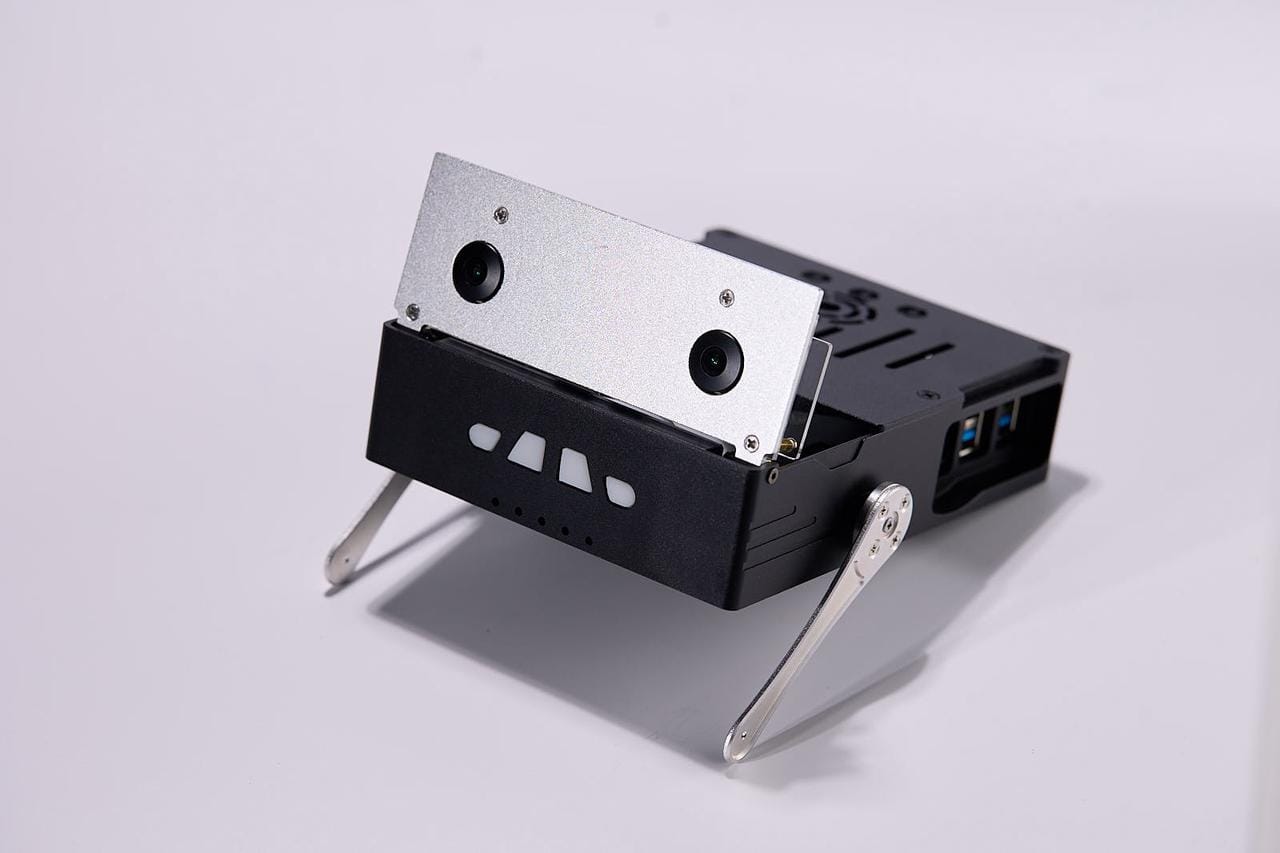
The product combines a stereo camera, ring-shaped LED light strip, microphone, speaker, and movable support legs. RDK OS and ROS are pre-installed, along with sample programs for stereo depth estimation, gesture interaction, and voice interaction.
Another Magicbox demo shows body keypoint detection. It locates a person's keypoints and draws a skeleton in real time, demonstrating an additional human-robot interaction capability on X5.
Body keypoint detection and the other perception algorithms shown on Magicbox can also run on other D-Robotics platforms, provided the selected hardware meets the model, sensor-interface, and latency requirements.
Match Each Workload to the Right Platform
Robot Workload | Sensor and Demonstrated Capability | Platform and Core Specs | Electronica Exhibit |
Monocular target detection and lawn segmentation | One monocular camera; boundary recognition, obstacle avoidance, and return to charge; reference lawn area up to 600 m² | Sunrise 3; 5 TOPS; 4× Arm Cortex-A53 at 1.5 GHz | Joint Fibocom and D-Robotics lawn mower solution |
Stereo depth for spatial perception | Magicbox stereo camera with a stereo-depth estimation demo | RDK X5; 10 TOPS; 8× Arm Cortex-A55 at 1.5 GHz; 2× 4-lane MIPI CSI | RDK X5 Magicbox product demo |
Higher-definition stereo depth across challenging scenes | Stereo camera; D-Stereo with 640 × 576 input, up to 27 FPS, Transformer-based global large-disparity search, and indoor/outdoor, day/night, near/far coverage | RDK S100; 80 TOPS; 6× Arm Cortex-A78AE at 1.5 GHz; 4× Arm Cortex-R52+ at 1.2 GHz | RDK S100 D-Stereo demo |
Body keypoint detection and human-robot interaction | Camera-based skeleton keypoint demo | RDK X5 shown on Magicbox; other suitable D-Robotics platforms supported | Magicbox body-keypoint demo |
Choose the platform around the full workload. Sunrise 3 suits focused monocular detection and segmentation, RDK X5 supports stereo depth and interaction applications, and RDK S100 provides more headroom for higher-definition stereo and concurrent models. Check sensor interfaces, model concurrency, latency, and control requirements before finalizing the design.
See D-Robotics at Electronica 2026
We will join Fibocom at electronica 2026 in Munich. The D-Robotics line-up includes the joint Sunrise 3 lawn mower solution, an X5 Magicbox stereo-depth demo, the S100 D-Stereo demo, and a Magicbox body-keypoint demo, together with stereo cameras and related hardware.
electronica 2026 runs from November 10 to 13, 2026, at Messe München. Visit Fibocom in Hall C2, Booth C2.724 to discuss edge computing and perception algorithms for the next generation of mobile robots.